Chinese equity slump: AI valuations collapse as state fund enters market
The STAR 50 index has fallen 40% since June, erasing $2.4 trillion in value while Beijing debates whether stimulus can revive investor confidence before key party meetings.
By Ethan Harrison ·
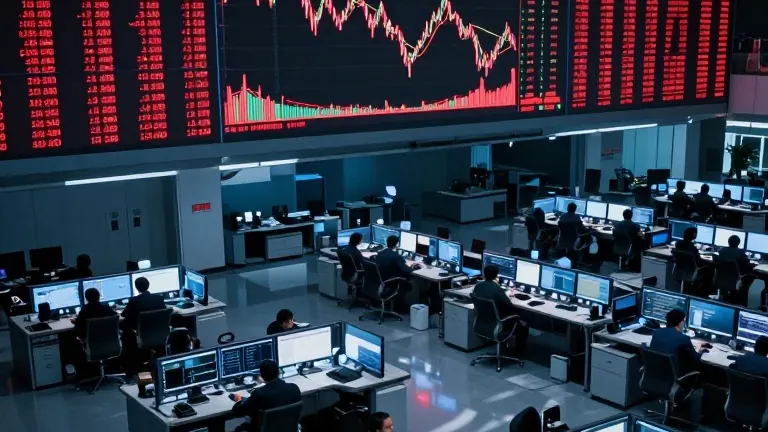
Beijing’s aggressive push to dominate artificial intelligence is colliding with a fragile domestic economy, triggering a massive sell-off in Chinese equities. Investors are pulling out of technology stocks as they weigh the gap between state ambition and weak consumer spending. This disconnect is forcing a hard look at whether government subsidies can sustain a market that relies heavily on private capital.
The financial damage is substantial. Bloomberg reports that $2.4 trillion in value has vanished from the Chinese stock market since May. The STAR 50 Index, which tracks tech and innovation firms on the Shanghai exchange, has dropped 40% since June. Broader indexes of major companies have also slipped by roughly 20% over the same period. These figures indicate a broad-based retreat from risk assets across the country.
The sector is heavily weighted toward AI. Goldman Sachs data shows that AI stocks represent over 40% of the total market value in China and Hong Kong. This concentration means that a decline in AI valuations sends shockwaves through the entire domestic market. The pressure is compounded by the United States’ ongoing restrictions on Chinese technology. Washington has already banned Chinese humanoid robots on national security grounds and is considering limits on Chinese components in data centers.
Dan Wang, the China director for the Eurasia Group, attributes the decline to a mix of macroeconomic factors. She notes that profit margins are lower than expected while US interest rates rise and domestic demand remains soft. “There is a general anxiety among technology companies about whether or not the state-backed model would work in the face of weak consumer demand,” Wang said. She added that embodied intelligence, a key focus for Beijing, has not yet generated mass market profits.
Beijing is responding with new financial tools. A 60 billion yuan state-backed AI investment fund began allocating capital to domestic developers this month. The government also launched a robotics initiative, viewing it as a solution to the aging population and shrinking workforce. However, demand for these robots is currently driven by government agencies and research institutions rather than households, where the products remain too expensive for practical use. Shares in Unitree, a leading robot manufacturer, have halved since trading began in August.
Policymakers face political constraints that limit their ability to intervene. China is restricting overseas investment to keep capital domestic, with new regulations taking effect on December 1. Despite this, domestic investment has not surged. Wang calls potential stimulus measures “high risk” because the next party leadership structure is being finalized. Any failure could lead to accountability for the officials who proposed the policies. The top Communist Party officials are gathering this week for the fifth plenum to prepare for the 21st Party Congress, where Xi Jinping is expected to secure a fourth term. No major stimulus is expected during this sensitive window.
The contrast with the United States is stark. Anthropic, the maker of the Claude chatbot, filed for an initial public offering on Monday that could raise up to $100 billion. Such a debut would be among the largest in history. China has no comparable IPO on the horizon. While Wang sees optimism in AI research and satellite sectors due to their military links, the broader market remains tense. The global AI boom is expected to continue for at least another year, but the internal Chinese market is struggling to find its footing.
Source: The Guardian
More Business · Business Watchdog · Report a business · Got a Story?